

Studio Archive: The Essential Guide to Cataloging Your Art
Making sense of your life's work—why cataloging is a gift to your current self and future curators and collectors.

Let’s talk about cataloging your personal art (artists) or art collection (art collectors). If that sentence made you want to stop reading, I get it. This might feel like tedious housekeeping, but it is actually a vital act of studio tending. It is important in terms of both managing your current art career as well as your future legacy.
As part of my recent independent curatorial work, I’m cataloging hundreds of works of art by a single artist. This project, along with a few other recent conversations, has me thinking a lot about artists’ legacies and why some persist and others don’t.
For those new to this notion, an inventory or catalog includes a record of each work in your collection (as an artist or a collector). I maintain one for my own art using a software platform I’ll share more about below. I started actively inventorying my work about nine years ago and it makes my professional life easier in many ways. The software used allows me to quickly see the basic info about a piece (more on that below), along with where it has been exhibited, if it has been sold, etc.
As a curator, my goals are different but much of the information needed is the same. Some artists keep inventory spreadsheets (sooooo helpful) but many artists and art collectors maintain very few records, making the process of cataloging the art more challenging for those working with it later on.
Legacy
Legacies are maintained because someone–the artist or an advocate–has done a lot of work to make sure the artist is remembered. A good example of this is Vincent van Gogh’s sister-in-law, Jo. She got his work out into the world and fostered the legacy we know today.
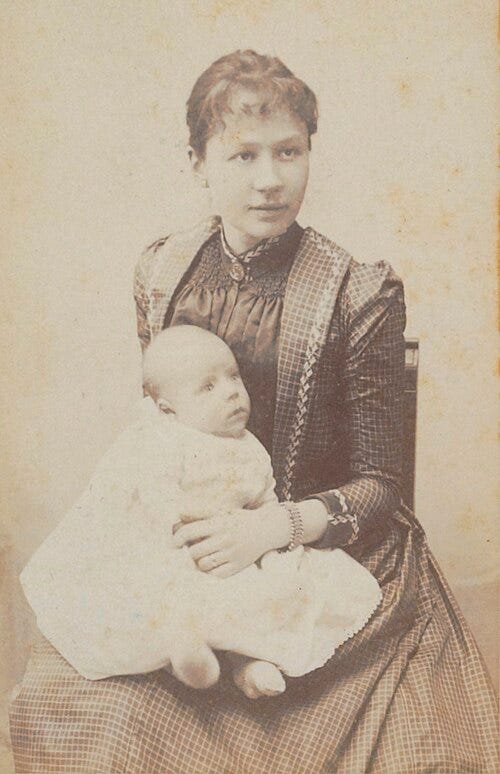
Artist legacies are an interesting thing. Some surprise us, like the emergence of Hilma af Klint’s spiritual works, which she stipulated could not be shown for twenty years after her death. Her nephew, Erik af Klint, ended up opening the stored works in the 1960s and established a foundation to protect her legacy before her work started to become known many years later. Side note: there is currently an interesting legal battle going on between Erik and the board of the foundation he established.
Legacies are complex and work is re-contextualized as it is exhibited and researched. There is a lot we can’t control. But there are some things we can and should manage.
One more thought before I get into some practicalities:
While all artists need to and should consider their legacy, some are more likely to do so than others. Heavily on my mind as of late is the how and why of who gets in the room, whose legacy remains with us decades or centuries later. I’ve likely been annoying some of my artist friends lately with the refrain of “consider your legacy” because for too many reasons to list here, women and other underrepresented groups of artists are still less likely to be invited and/or walk in the room themselves. As an artist, I’ll admit that I’m not great at pitching my own work, even though from my view on the other side of the desk, I know it’s important to do so. As a curator, I’ve fielded many more pitches from men (likely 70% more). We are not all socialized to open doors. In fact, for many it’s quite the opposite, making walking in the room, so to speak, quite daunting.
While I don’t have many answers to these ongoing challenges, the step of documenting one’s work is a beginning.
Be ready to have it seen and shared.
How to Catalog Your Art
While documenting work is a broad topic, let’s focus specifically on creating a inventory catalog of your art today.
Where to house your art catalog records:
For my personal art, I use the cloud-based software product Artwork Archive. For museums and collecting organizations, there are more museum-specific products I’d recommend, but Artwork Archive works well for me and could also be used to catalog a private collection. While I like the ease of use and additional functions of this software, you can also simply use a spreadsheet to create an inventory.
It can feel daunting to get a project like this started so here are a few thoughts before we move on:
Rome wasn’t built in a day. This is an ongoing practice and not something that needs to be done overnight.
Incomplete documentation is better than no documentation. It doesn’t need to be perfect.
Artists, you don’t need to catalog everything. I didn’t begin making my best work until my mid to late thirties. For that reason, as well as believing that done is better than perfect, I haven’t documented much of my back catalog. That may be a project for the future. Who knows?
Collectors, I do recommend you document your entire collection.
Art Record Essentials
Once you’ve decided on your platform, here are the essential categories to document for each work of art.
-Unique id number
This is important for many reasons. You’d be surprised at how often artists use the same title for different pieces. Titles do not make good identification references. Ideally, you also tag the art itself with this number, using conservation-safe methods such as light pencil on the back of 2-D works and/or tags that can be safely attached to the work. I like paper tags on cotton string that can be attached to wire or safely placed on or near sculpture.
For my art, I use a two part id number system, referencing the year in which the work was made and in what order it was made that year. So, the id number for the first piece I made this year is 2026-1. The second piece made this year is 2026-2 and so forth. This might actually be the default setting on the software I use (can’t recall if I set this up years ago or it is the default) and it’s inspired by the three-part numbering system museums use.
-Image of the artwork
-Title of the work
-Date of work. Get as close to the actual date as possible. Use the exact year if you know it. If not, use an approximate date such as “circa 2010s” or “circa late 20th c.”
-Medium: For 2-D works, this includes the substrate it’s made on. For example, “Oil on canvas board.” Three-dimensional works should include a list of all materials used, if possible.
-Size of the art (h x w x d). Height comes first for art measurements.
-Value: List the current insurance value or price (if for sale). For any piece that’s sold, list the sales price.
-For collectors—please for the love of all things art and to bring great joy and ease to a future curator’s life, document where, when, and how (purchase, gift, or donation) you acquired the work. If you know the provenance of the work prior to your acquisition of it and you document that, too, you get an A++. The future thanks you.
There are many other things that can be documented, such as size of frames, name of the collector who purchased the work, exhibitions, images of the back of the art, signature, condition of the art, and more. Software programs make this easy because the categories are already set. All you need to do is plug in the information.
But, if you simply create a spreadsheet with only the essential categories listed above, you are ahead of most.
Wishing you a creative day,
Shan